


Warehouse work in the Netherlands: what you need to know in 2026 as an (international) worker
The Netherlands is the logistical heart of Europe. The Port of Rotterdam is the largest on the continent. Schiphol Airport handles tons of cargo every day. And in the region around Aalsmeer and Haarlemmermeer, distribution centres ship millions of flowers, plants, and products to 44 countries every morning — before breakfast is even over.
All these goods need to be received, stored, sorted, packed, and shipped. This work isn’t done by robots. It’s done by people. And there simply aren’t enough of them. That’s why warehouse work is one of the most accessible ways to start working in the Netherlands right away. In this article, we explain what you can expect when working in a Dutch warehouse.
What is warehouse work in the Netherlands exactly?
Warehouse work is a broad term for all roles involved in receiving, storing, picking, processing, and shipping products in a warehouse or distribution centre. Picture facilities of 10,000 m² or more, filled with racks up to six metres high, conveyor belts, beeping scanners, and teams moving through the aisles in structured routes.
What you do on a daily basis depends on your role and the type of warehouse, but at its core, warehouse work revolves around four key processes:
- Receiving goods (inbound). Unloading trucks, checking boxes for damage, registering products in the warehouse management system (WMS), and placing them in the correct location in the racks. This is also known as “put-away.”
- Order picking. Using a hand scanner or voice headset, you move through the warehouse to collect products for customer orders. This is the most common entry-level role in Dutch logistics and the fastest way to start without experience. → You can read everything about order picking in our separate article.
- Packing and preparing shipments (outbound). Packing products, labelling them, stacking them on pallets, and preparing them for transport. Packing work usually takes place at a fixed workstation and is slightly less physically demanding than order picking.
- Internal transport. Moving pallets and roll containers using an electric pallet truck or forklift. A certificate is required for forklift work; for an electric pallet truck, it is not.
Around these core tasks, a warehouse also runs on returns processing, inventory management, quality control, and cleaning. In a well-functioning distribution centre, everyone supports each other.
Many of these tasks are repetitive: you perform the same actions hundreds of times a day. However, most warehouse workers don’t experience this as boring. The pace is high, you work in a team, and before you know it, your shift is over.
What warehouse roles are there?
Not all warehouse work in the Netherlands is the same. There are different roles, ranging from entry-level to more specialised positions. Below are the most common roles in Dutch distribution centres:
Orderpicker
The most popular entry-level role in logistics. You collect orders from the shelves using a hand scanner or pick list and prepare them for shipment. No experience required; you will learn the scanning system and warehouse routes within your first two to three working days.
Forklift driver / reach truck driver
You move pallets and heavy goods using a forklift or reach truck. A valid certificate is required. The salary is higher than entry-level roles: between €16.50 and €19.00 gross per hour. Don’t have a certificate yet? Through ABflexkracht, you can complete the training and start earning more right away.
Packer / packing employee
You work at a fixed workstation where you pack products, apply labels, and prepare boxes or pallets for shipment. Less walking than an order picker, but more fine motor skills involved. A good option if you prefer not to walk 10+ kilometres through the warehouse all day.
Warehouse employee (all-round)
A broad role where you perform a mix of tasks: receiving, storing, picking, packing, and checking. More variety, but you need to be flexible and able to switch quickly between tasks.
Logistics employee / shipping clerk
You coordinate the flow of goods: what goes where, when, and by which transport? This role comes with more responsibility and usually requires some experience in logistics.

What kind of warehouses can you work in through ABflexkracht?
ABflexkracht is a cooperative with roots in the green sector, founded in 1968. As a result, our logistics vacancies are mainly with:
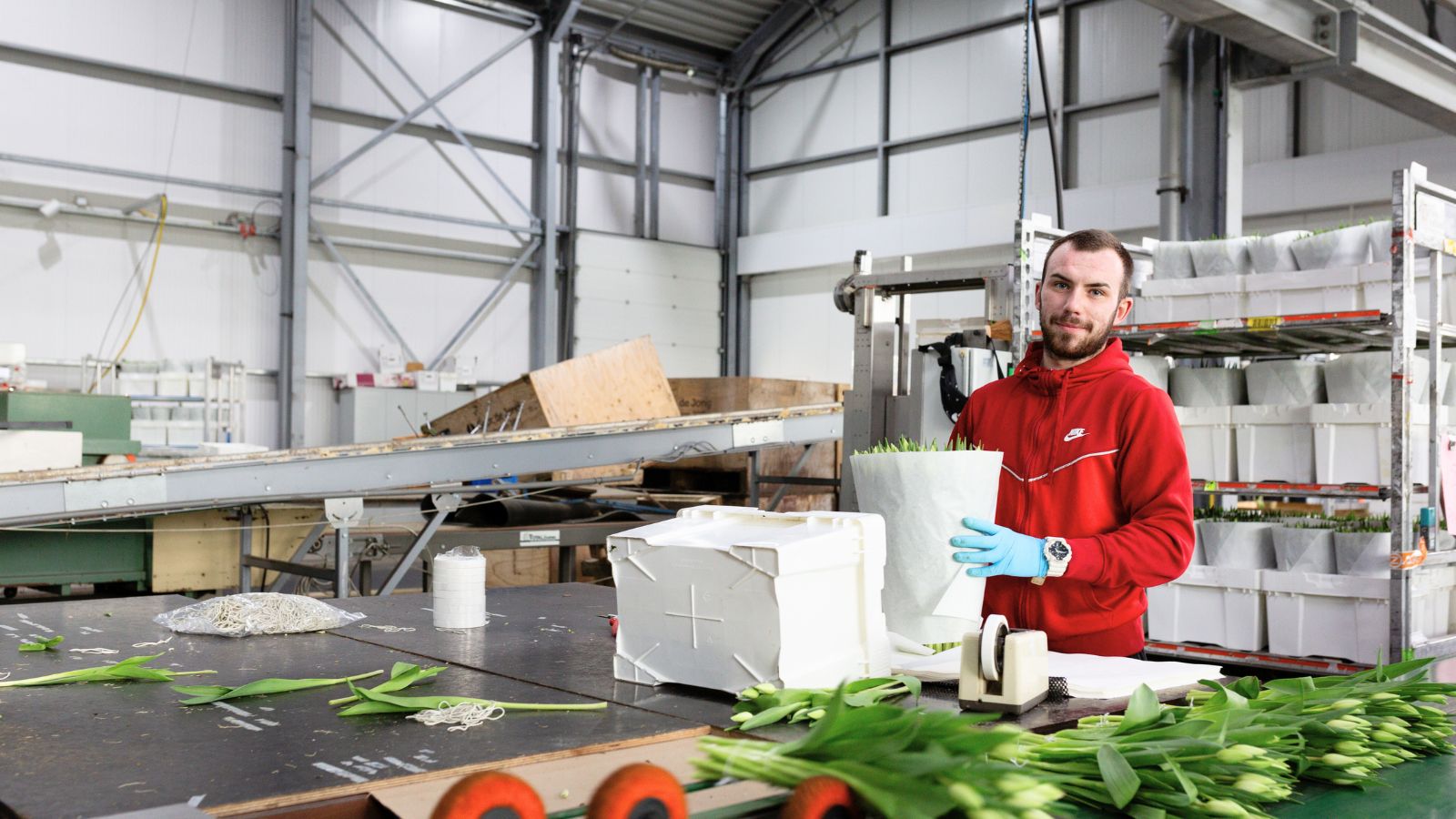
- Flower logistics and auctions: distribution centres and auction sites in the Aalsmeer, Rijsenhout, and Bollenstreek regions. Here, millions of flowers and plants are sorted, packed, and shipped across Europe every day. What makes logistics in the floriculture sector unique? Flowers are a fresh product and must be shipped within hours. This creates a level of pace and urgency you won’t find anywhere else.
- Plant nurseries and propagation companies: logistics focused on packing, labelling, and shipping young plants and potted plants to garden centres across Europe. These environments are often smaller in scale and offer more variety in the work.
- Food and retail distribution centres: ABflexkracht also places employees in distribution centres outside the green sector, for example in food, retail, and e-commerce.
→ Good to know: the atmosphere and pace in a flower warehouse are different from those in a large e-commerce distribution centre. In the floriculture sector, you work with a fresh product, often in a smaller team, and the working environment is more personal. In a large DC, you typically walk more kilometres per day and the pace is often more tightly managed with picking targets. When you register with ABflexkracht, we discuss which type of warehouse suits you best.
What does a workday in a warehouse look like?
No two warehouse shifts are exactly the same. The workload depends on the incoming orders, scheduled transport and the type of products being handled. At the start of your shift, your team leader explains where you will be working, which orders have priority and what your team needs to complete. In flower logistics, the pace is often determined by the product. Flowers and plants are fresh and cannot remain in the warehouse for long. Orders must be sorted, checked and prepared before the trucks leave for customers and auctions across Europe. This means some parts of the shift can be busy, especially when several shipments need to be completed at the same time. You usually work in a specific department, such as order picking, packing or shipping. However, priorities can change during the shift. When one department becomes busier, your team leader may ask you to help with another task. You therefore need to work accurately, follow instructions and be comfortable working as part of a team.
| 6:00 – 6:15 | Je komt binnen, meldt je aan bij je teamleider en krijgt een korte briefing. Welke orders hebben vandaag prioriteit? Op welke afdeling ga je werken? |
| 6:15 – 9:30 | Je eerste werkblok. Afhankelijk van je functie ben je aan het orderpicken, sorteren, inpakken of laden. In bloemenmagazijnen is dit vaak het drukste moment: de bestellingen van die ochtend moeten vóór het middagtransport de deur uit. |
| 9:30 – 9:45 | Pauze. Koffie, even zitten, benen rust geven. |
| 9:45 – 12:30 | Je werkt verder. Soms wissel je van taak, afhankelijk van de drukte en wat je teamleider nodig heeft. |
| 12:30 – 13:00 | Lunchpauze. |
| 13:00 – 14:30 | Je rondt de laatste orders af, brengt materialen terug, ruimt je werkplek op en levert je scanner in. |
| 14:30 | Einde dienst. |
Afhankelijk van de opdrachtgever zijn er soms ook avonddiensten, nachtdiensten of ploegendiensten. Avond- en nachtwerk levert extra toeslagen op, soms tot 50% bovenop je basisuurloon.
Is warehouse work physically demanding?
Yes, it is physical work. But “demanding” means different things to different people, and it strongly depends on your role and the type of warehouse.
What to expect physically:
As an order picker, you walk an average of 10 to 15 kilometres per day in safety shoes with steel toes. You regularly lift boxes and packages weighing between 5 and 15 kilos. You are standing and walking for most of your shift. In temperature-controlled warehouses the temperature ranges between 2°C and 15°C to keep products fresh.
What you’ll feel in the first weeks:
During your first week, you will likely experience muscle soreness in your legs, feet, and back. This is normal and will pass. After about two weeks, your body adapts to the rhythm. Good work shoes are essential. At ABflexkracht, you will receive safety shoes from us.
Pick targets: speed versus quality
In many warehouses, your productivity is measured via a scanner: a certain number of picks per hour. This can feel stressful in the first few days. At most workplaces, starters are given time to learn the system properly before speed becomes a focus. Avoiding picking errors is always more important than speed at first. Speed will come naturally.
Not too demanding to hold you back:
You don’t need to be an athlete to work in a warehouse. Tools are available to keep the work manageable: electric pallet trucks for heavy pallets, roll containers to move boxes, and ergonomic working heights at packing stations. Most people who start in warehouse work are surprised at how quickly they get used to it.

How much do you earn with warehouse work in the Netherlands in 2026?
The statutory minimum wage in the Netherlands as of 1 July 2026 is €14.99 gross per hour for employees aged 21 and over (source: Rijksoverheid.nl). The Dutch minimum wage is among the highest in Europe. For comparison, the German minimum wage in 2026 is €13.90 per hour (source: Bundesregierung.de).
| Function / experience level | Gross hourly wage (2026)* | With evening/night allowance (indicative) |
|---|---|---|
| Starter order picker / packer (21+) | € 14,99 – € 16,00 | € 18,74 – € 24,00 |
| Experienced warehouse employee | € 16,00 – € 18,00 | € 20,00 – € 27,00 |
| Forklift driver (with certificate) | € 16,50 – € 19,00 | € 20,63 – € 28,50 |
The hourly wages in this table are indicative and based on the sector collective labour agreement (CAO) of the client – which temporary workers are entitled to from 1 January 2026 – and the salaries that ABflexkracht applies in practice. Allowances may vary depending on the applicable CAO.
On top of your hourly wage, you receive:
- Holiday allowance: 8.33% of your gross annual salary, usually paid in May
- Overtime compensation: allowance varies per client and collective labour agreement
- Allowances for irregular shifts: evening, night, and weekend shifts provide extra pay
- Pension accrual through StiPP: from 2026, the gross pension contribution is 23.4% of the pension base, of which 15.9% is paid by the employer and 7.5% by you as the employee
- Travel allowance if applicable with the client
Your rights as a temporary worker in 2026: equal employment conditions
Since 1 January 2026, an important change has been introduced for temporary workers in the Netherlands. Your total employment package – salary, allowances, holiday days, pension, reimbursements, and all other conditions – must be equal in value to that of permanent employees performing the same work at the client’s company. Not every individual element has to be identical, but the total value must be.
In practice, this means: equal work = equal total compensation. It doesn’t matter whether you are from Poland, Romania, or the Netherlands, or whether you work through an agency or are directly employed.
The phase system: how you build more security
As a temporary worker at ABflexkracht, you work according to the phase system of the ABU Collective Labour Agreement (CAO):
- Phase A (up to 52 worked weeks): You start with flexible contracts. You get to know the job, the client gets to know you, and you build experience.
- Phase B (after 52 weeks, maximum of 6 contracts within 3 years): You receive contracts with a fixed number of hours. More stability in your work and income.
- Phase C: You receive a permanent contract. Maximum security.
The longer you work, the more rights and security you build. ABflexkracht supports you through every phase.
Language and qualifications: what do you really need?
- You don’t need to speak fluent Dutch or English
Warehouse work in Dutch logistics is highly international. You will work daily in teams with colleagues from Poland, Romania, Bulgaria, Spain, and many other countries. In many cases, the software on your hand scanner can be set to Polish, Romanian or English. Basic English is usually enough to get started safely and effectively.
At ABflexkracht, our coordinators can support you in Polish, Dutch or English, from your first phone call to your first working day and beyond. - You don’t need a diploma
For most entry-level warehouse roles you need no experience and no diploma. You will learn the scanning system and warehouse routes during your first days on the job.
Do you already have a forklift or reach truck certificate? Make sure to mention this when you register. It can immediately lead to a higher salary. Don’t have a certificate yet but want to get one? ABflexkracht can help you with the training.
A reliable recruitment agency in logistics: how do you recognise one?
Abroad and on social media, there are stories about unreliable agencies in the Netherlands that exploit workers, deduct excessive amounts for poor housing, or make promises they don’t keep. Unfortunately, these stories are not unfounded. There are still untrustworthy parties in the industry. How can you protect yourself? Always look for these three certifications, and verify them yourself:
1. ABU membership
ABflexkracht is a member of the ABU, the Dutch association for recruitment agencies. Membership means we are audited annually to ensure correct compliance with the collective labour agreement, fair pay, and good employment practices. You can verify the ABU membership of any recruitment agency at abu.nl.
2. SNA certification (NEN 4400-1)
ABflexkracht holds the NEN 4400-1 certification from the SNA. This means an independent inspection body verifies that we correctly pay wage taxes and VAT, comply with minimum wage laws, carry out identity checks, and meet all legal obligations. This certification protects you from agencies that fail to properly pay taxes or social contributions; a common issue with unreliable agencies. You can verify the SNA certification at normeringarbeid.nl.
3. SNF-certified housing
Finding housing in the Netherlands is extremely expensive and difficult, especially when you have just arrived. ABflexkracht arranges accommodation for you. All our housing is SNF-certified, guaranteeing that you live safely, have good Wi-Fi, share a bedroom with a maximum of two people, and that the property meets fire safety standards and is regularly inspected. You can check whether a housing provider is certified via flexwonenregister.nl.
Tip for couples: Do you and your partner want to work and live together? Let us know right away. We almost always place couples together in one shared room and aim to have you working in the same warehouse as well.
5 tips from our coordinators for your first working week
Are you about to start working in a Dutch warehouse? With these tips, you’ll get through your first weeks smoothly:
- Dress in layers. In flower warehouses, temperatures range between 2–15°C. You may feel cold, but because you move a lot, you will also start to sweat. Wear a T-shirt, a sweater or fleece on top, and possibly a body warmer so you can easily adjust throughout the day.
- Wear thick socks. You will receive safety shoes with steel toes from us. Wear good, thick work socks to prevent blisters during those first 10–15 kilometre days. This may be the most important tip in this entire article.
- Download a translation app. Don’t fully understand an instruction from your team leader? Use Google Translate on your phone. No one minds if you double-check — it prevents mistakes and misunderstandings. Many team leaders in Dutch warehouses are used to working with multilingual teams.
- Use the bike. Is your accommodation close to the warehouse? Depending on the distance, ABflexkracht can provide a loan bike. It’s healthy, typically Dutch, and saves you time.
- Speak up. Don’t feel well? Don’t understand something? Is there a safety issue? Say something. At ABflexkracht, your contact person is available in your native language. You don’t have to solve problems on your own.
How do you get started with ABflexkracht?
Step 1: Apply online. Fill in the registration form and upload your CV. This takes about 5 minutes. You can complete the form in Dutch, English or Polish.
[Go to the registration form]
Step 2: Introduction interview. A recruiter who speaks your language will discuss your experience, preferences, and availability. We will also ask about your certificates, driving licence, and whether you want to work as a couple or individually. We then match you with a warehouse or distribution centre that suits you.
Step 3: Everything is arranged. Contract, health insurance, BSN registration, and for EU workers also SNF-certified housing and transport. You don’t have to arrange any of this yourself.
Step 4: Start working. On your first day, you will receive a tour, safety instructions, and an explanation of the scanning system. After that, you start working right away alongside an experienced colleague.
View our logistics vacancies and register today →

Ready to start your career in the Netherlands?
ABflexkracht is a cooperative of entrepreneurs in the green sector, founded in 1966 and based in Rijsenhout (municipality of Haarlemmermeer). With nearly 60 years of experience, we support international workers in finding jobs in Dutch logistics, horticulture, and distribution.
[Bekijk onze vacatures voor magazijnwerk en schrijf je in binnen 5 minuten →]
Gerelateerde verhalen
What will you earn as an EU-worker in the Netherlands in 2026?
Are you an EU citizen considering working in the Netherlands? This…

Work in the Netherlands for women: ABflexkracht has it!
Would you like to work in the Netherlands as a woman? You might thi…

New collective labor agreement (cao) for temporary workers in 2026: what will change in the Netherlands?
From January 1, 2026, significant changes will take effect for temp…

Working and Living in the Netherlands Immediately in 2026: how to secure a comfortable home right away
Are you ready to start working immediately and want to ensure a com…