


Working as an order picker: salary, tasks, and how to get started in 2026
Looking to start quickly without a diploma, avoid sitting behind a desk all day, and earn a solid salary right away? Then the role of an order picker is your ideal step in 2026.
Order picking is one of the most popular entry-level roles in logistics. But what exactly do you do during a typical day? What is the reality on the work floor? And what do you actually take home? In this article, we give you an honest look inside the warehouse.
What does an order picker do?
As an order picker, you are responsible for collecting orders in a warehouse or distribution centre and preparing them for shipment. Don’t think it’s mindless work. Using a hand scanner, wrist scanner, or voice picking system (a headset that tells you where to go), you piece together dozens of orders every day. Your daily tasks include:
- Collecting orders from shelves, on foot or using a pallet truck/EPT (electric pallet truck).
- Scanning products and keeping inventory accurate in the system.
- Checking orders for accuracy and damage.
- Packing, labelling, and preparing products at the correct dock for shipment.
- Keeping your workspace organised and safe.
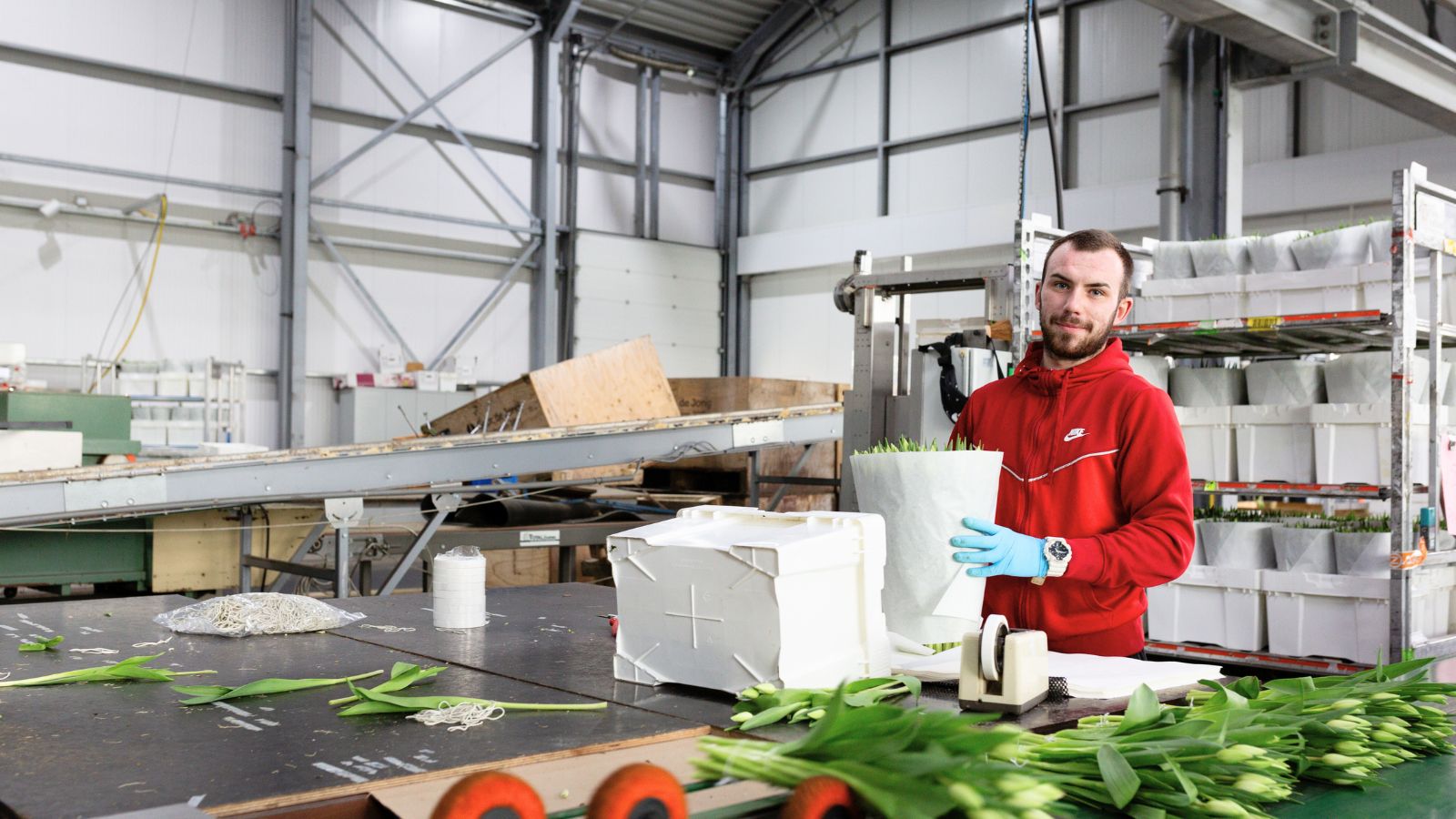
At ABflexkracht, you will often work in warehouses within the green sector and horticulture, such as distribution centres for flowers and plants. The pace is usually high, as fresh products need to be processed and shipped quickly. This makes the work active and varied. It’s essentially a large logistical game where you and your team try to beat the clock. Of course, we also offer logistics vacancies in other sectors.
What does a workday as an order picker look like?
No two days are identical, and working hours can differ significantly between employers and warehouses. A typical shift usually begins with a short briefing. You gather with your team to discuss the priorities for the day; for example, making sure urgent export orders are prepped and ready to leave on time. Once everyone knows the plan, you head into the warehouse to start picking orders, scanning products, and efficiently following your route through the aisles.
Throughout your shift, there are scheduled breaks to grab a coffee, have lunch, and recharge. In between these breaks, you keep the flow of orders going. The work is dynamic: besides picking orders, you might also step in to help with packing, checking shipments, or general clean-up tasks.
Toward the end of your shift, you wrap up the last few orders, return your scanner and materials, and tidy up your workspace so it is ready for the next team.
Depending on the employer, you may work standard day shifts, evening shifts, or rotating shifts. This variety makes order picking an attractive job both for people who prefer a fixed, predictable routine and for those who are looking for more flexibility in their schedule.
Is working as an order picker physically demanding?
Yes, it is physical work. But to clear up a common myth: you definitely don’t need to be a bodybuilder to do this job. Heavy pallets are moved using electric pallet trucks.
However, you should keep in mind that you will walk an average of 10 to 15 kilometres per day. You will also regularly lift boxes (usually between 5 and 15 kilos). During your first week, you will definitely feel it in your feet and muscles. That’s normal. After a week or two, your body will get used to this active rhythm.
Good to know: if you work with us in the floriculture sector, the temperature in the warehouse may be lower than you are used to, to keep the products fresh. In those workplaces, warm and comfortable work clothing is always provided.
And what about workload and picking targets?
You may have heard stories about warehouses with extremely high targets. It’s true that there are goals (for example, a certain number of picks per hour). At most workplaces, starters are given time in the first weeks to learn the job properly. Speed will come naturally once you understand the processes.

How much do you earn as an order picker in 2026?
What you earn as an order picker depends on your experience, the employer, the type of shift, and the employment conditions at your workplace. As a starter aged 21 or older, your hourly wage in 2026 is usually around the minimum wage or slightly above. With experience, certifications, or shift allowances, this can increase.
Indicative gross hourly wage in 2026
| Experience level | Gross hourly wage (2026)* | With evening/night allowance (indicative) |
| Starter (21+) | €14.99 – €16.00 | €18.74 – €24.00 |
| Experienced / forklift certificate | €16.00 – €18.00 | €20.00 – €27.00 |
*The statutory minimum wage in the Netherlands is €14.99 gross per hour as of 1 July 2026 (source: Rijksoverheid.nl). The hourly wages in this table are indicative and based on the sector collective labour agreement (CAO) of the client, which temporary workers are entitled to from 1 January 2026, and the salaries we apply in practice as a staffing agency for logistics roles.
What makes the difference?
Your exact salary often depends on:
- your experience in logistics;
- the type of warehouse;
- shift work or irregular hours;
- certifications, such as forklift or reach truck;
- the agreements and conditions that apply at the client’s company.
On top of your hourly wage, you may receive:
- holiday allowance;
- accruals (reserves);
- pension contributions;
- travel allowance, if applicable;
- allowances for irregular shifts;
- overtime compensation.
Are you an EU temporary worker using our SNF-certified housing and health insurance through the agency? Then these costs may be deducted, which means the net amount you receive in your bank account will be lower. The exact amounts vary per situation.
A common misconception is: “You earn less through a staffing agency.” That’s not true. As of 1 January 2026, temporary workers are entitled to the same pay as permanent employees in the same sector. At ABflexkracht, we comply with these rules. Read more about the new CAO for temporary workers in 2026.
Do you need experience or a diploma?
No. Reliability, showing up on time, and being fit enough to stay active throughout the day are far more important than having a diploma.
Don’t speak Dutch? No problem. Logistics is an international environment. As long as you can use the scanner software in English (or Polish) and are willing to learn basic English or Dutch, you can start right away. Also read: Working in the Netherlands if you don’t (yet) speak Dutch.
→ Alternative: does walking 10 kilometres a day sound a bit too intense, but you still want to work in logistics? Ask us about packing jobs (more stationary work) or follow a forklift driver training course through us!

Who is order picking suitable for?
The great thing about order picking is that it suits a wide range of people:
Career switchers and newcomers
Coming from hospitality, retail, construction, or another sector and looking for something different? Order picking is an accessible transition. No diploma required, you can often start within a week, and there is high demand.
Students and part-time workers
Order picking can be flexible to schedule, and you learn directly on the job. You can often start quickly and the hours are predictable.
EU temporary workers
Are you from Poland, Romania, Bulgaria, or another EU country and want to work in the Netherlands? Order picking is a role that many people can start quickly. Dutch language skills are often not required, especially in internationally oriented workplaces. Through ABflexkracht, housing, insurance, and transport are arranged for you.
→ Curious about the exact rules for your situation? Read our article about what EU temporary workers earn in the Netherlands.
People who prefer physical work
Don’t want to sit behind a screen all day? As an order picker, you are constantly moving. You walk, lift, scan, and carry, at a pace that makes the day go by quickly.
Order picker via a staffing agency: what are the benefits?
You can apply directly to an employer, but many people consciously choose a staffing agency. There are several advantages.
You can often start faster: because a staffing agency is in daily contact with employers, there are usually multiple vacancies available at the same time. This makes the process faster than figuring everything out on your own.
You receive guidance: if you’re just starting out, it’s helpful to have someone who thinks along with you about the vacancy, your working hours, the work environment, and practical matters.
There is room to grow: starting as an order picker doesn’t have to be your final step. Many of our current forklift drivers and team leaders once started as order pickers. You can often move into a forklift driver role within 3 to 6 months by following training through us. Your hourly wage typically increases by €1.50 to €2.00.
Practical matters can be arranged: for many international workers, this is a major advantage. Think of support with housing, transport, and administration. See also:
ABflexkracht is affiliated with the ABU and registered in the SNA register (Stichting Normering Arbeid). This means we meet strict standards for fair pay, proper working conditions, and certified housing.
How do you get started as an order picker at ABflexkracht?
Step 1: Register online. Fill in the registration form and upload your CV. This takes about 5 minutes.
Step 2: We call you. A coordinator will discuss your experience, preferences, and availability.
Step 3: We match you. We connect you with a warehouse or distribution centre that suits you.
Step 4: Everything is arranged. Contract, insurance, and for EU workers also housing and transport.
Step 5: Start working. On your first day, you receive a tour and an explanation of the scanning system. After that, you start picking orders right away.
5 tips for your first week as an order picker
- Invest in your shoes. Your steel-toe safety shoes are your best friend. Break them in at home beforehand and wear good, thick work socks to prevent blisters.
- Bring water and a lunchbox. Many warehouses have a canteen, but it’s always useful to have your own food and drinks with you.
- Ask for clarification if something isn’t clear. No one expects you to know everything on day one. Don’t hesitate to ask your supervisor or colleagues if you don’t understand something.
- Lift with your legs. Prevent back problems. In your first week, you will receive instructions on proper lifting techniques at your workplace.
- Give yourself two weeks. You’ll probably feel exhausted in the evenings during your first days. That’s normal. Give your body time to adjust to the new routine.
Start working as an order picker through ABflexkracht!
Are you looking for a job where you can start quickly, stay active, and add value right away? Then order picking is a strong choice. You don’t need a diploma, you learn on the job, and you can often start in the short term.
At ABflexkracht, we not only help you find a job, but also support you with everything around it. From guidance and clear agreements to assistance with practical matters when needed.
[View our current order picker vacancies and register within 5 minutes →]
Gerelateerde verhalen
What will you earn as an EU-worker in the Netherlands in 2026?
Are you an EU citizen considering working in the Netherlands? This…

Work in the Netherlands for women: ABflexkracht has it!
Would you like to work in the Netherlands as a woman? You might thi…

New collective labor agreement (cao) for temporary workers in 2026: what will change in the Netherlands?
From January 1, 2026, significant changes will take effect for temp…

Working and Living in the Netherlands Immediately in 2026: how to secure a comfortable home right away
Are you ready to start working immediately and want to ensure a com…